


EMNLP 2026 Video grounding · Preference learning

Counterfactual videos
for grounded VLMs.

CounterVid creates controlled counterfactual videos that differ in action or temporal order—then uses them to teach video-language models to trust visual evidence over language priors.

Dataset and three model checkpoints available now

counterfactual_pair_017 grounded
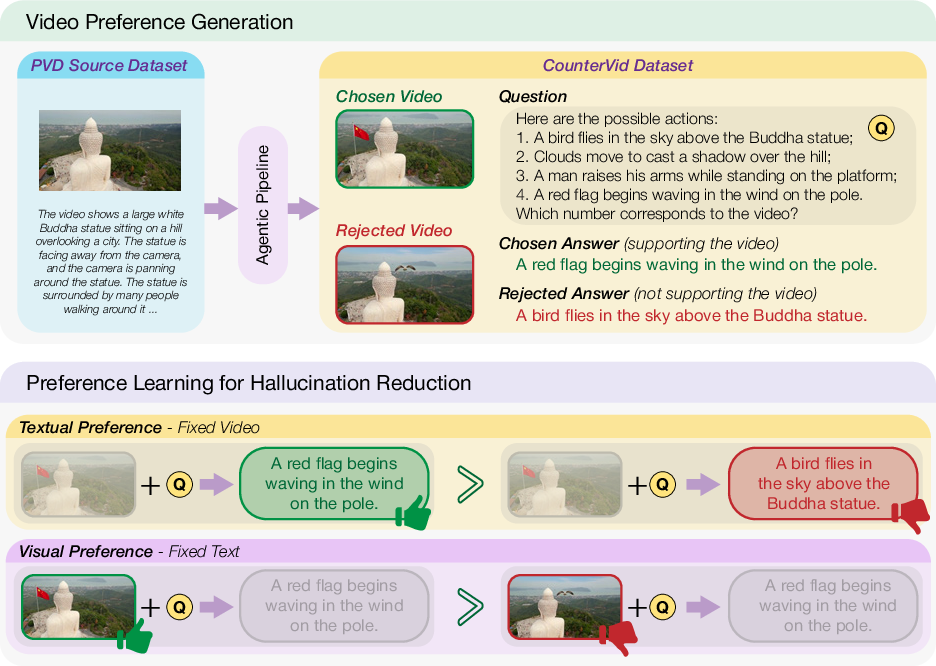
CounterVid preference generation and learning pipeline
V+ preferred video versus V counterfactual video

Tobia Poppi1,2,3, Burak Uzkent1, Amanmeet Garg1, Lucas Porto1, Garin Kessler1, Yezhou Yang1,
Marcella Cornia2, Lorenzo Baraldi2, Rita Cucchiara2, Florian Schiffers1

The problem

A model can name every object
and still miss what happened.

Strong VLMs often infer actions and event order from linguistic plausibility instead of fine-grained motion. CounterVid turns those near-miss cases into supervision.

01

Action misidentification

The scene is right, but the action is wrong. Semantically matched clips force the model to attend to motion rather than static context.

opens the phone closes the laptop
02

Temporal misordering

The events are present, but their order is not. Controlled permutations isolate whether the model actually follows the timeline.

A → B → C B → C → A

Abstract

Video-language models achieve strong multimodal understanding but remain prone to hallucinations, especially when reasoning about actions and temporal order. We introduce a scalable framework that synthesizes videos differing only in action dynamics or temporal structure while preserving scene context. From these controlled counterfactuals, we build CounterVid and train with MixDPO—a unified objective combining textual and visual preferences—to improve grounding and temporal sensitivity across VLM families.

Generation pipeline

One scene.
Many plausible actions.

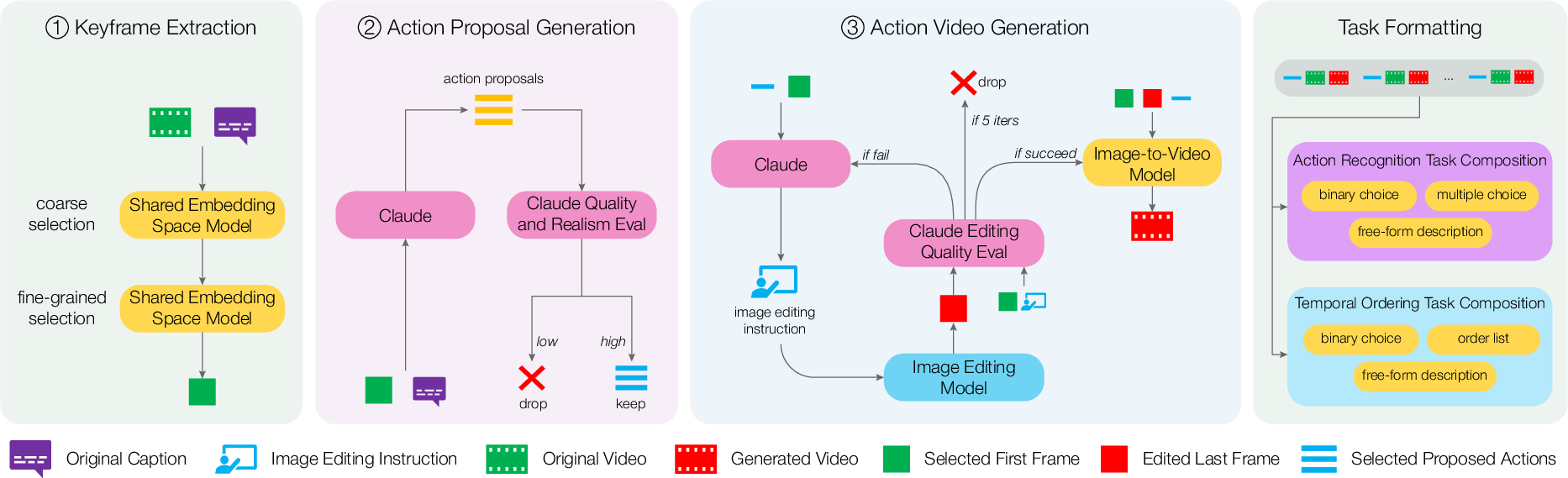
One anchor frame becomes a family of plausible, same-scene action videos—semantic hard negatives built for fine-grained visual reasoning.

Four-stage CounterVid generation pipeline
  1. 01

    Find the anchor

    Coarse-to-fine frame retrieval selects a representative, caption-aligned starting state.

  2. 02

    Propose alternatives

    A multimodal LLM suggests plausible, distinct, and visually expressible actions.

  3. 03

    Generate the motion

    Image editing creates end states; image-to-video diffusion connects them coherently.

  4. 04

    Format the tasks

    Clips become action-recognition and temporal-ordering preference pairs at scale.

MixDPO

Teach both sides
of visual grounding.

A grounded model should choose the right answer for a video—and assign that answer to the right video. MixDPO optimizes both directions in one objective.

t-pref Fixed video

Textual preference

Prefer a grounded answer over a plausible but visually unsupported answer under the same video.

Vvideo
A+ grounded A hallucinated
v-pref Fixed text

Visual preference

Prefer the correct visual evidence over a same-scene counterfactual for the same question and answer.

V+ correct V counterfactual
Q,Atext
Unified objective

MixDPO = ℒt-pref + λ ℒv-pref

output grounding + input sensitivity

CounterVid dataset

Controlled contrast,
at synthetic scale.

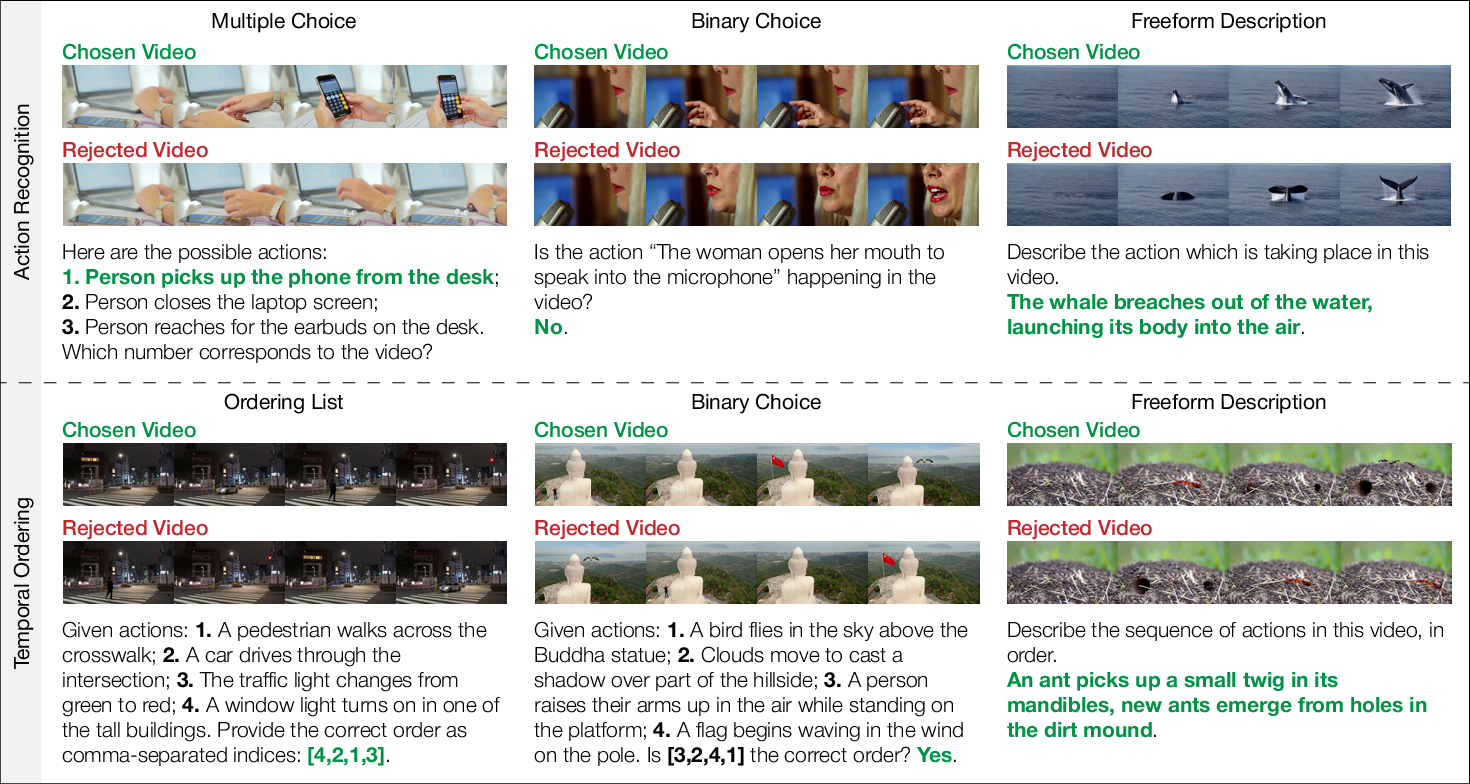
26,167 training preference pairs built from synthetic clips with controlled action variations, plus 2,910 held-out examples.

Free-formBinaryMultiple choiceOrder list
Explore the dataset
Qualitative CounterVid dataset samples for action recognition and temporal ordering
Action recognition and temporal ordering across four complementary task formats.
Chosenvisually grounded
Rejectedsemantically plausible

Results

More sensitive to motion.
Less tempted by priors.

Across Qwen2.5-VL and InternVL3 backbones, MixDPO improves action recognition and temporal ordering, transfers positively to standard video hallucination benchmarks, and largely preserves general video understanding.

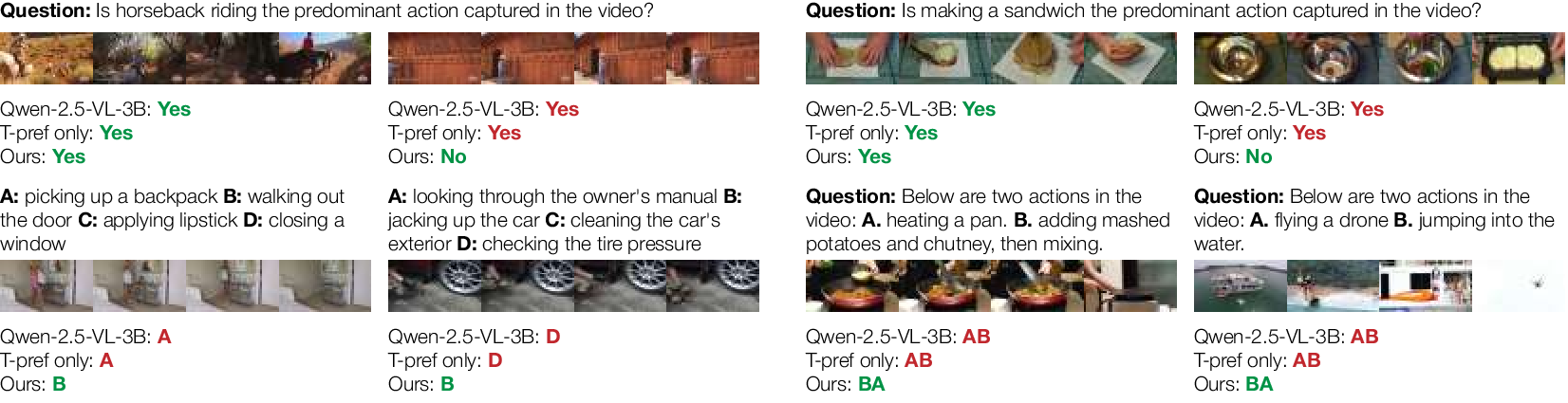
Qualitative examples comparing baseline and CounterVid-aligned model predictions
Qualitative examples: MixDPO corrects action and sequence errors missed by the base and text-only preference models.

Research story

Built during an internship
at Amazon Prime Video.

This research was conducted during Tobia Poppi's Applied Scientist internship with the Amazon Prime Video team in Seattle.

Tobia on GitHub

Citation

Build on CounterVid.

If this work helps your research, please cite the paper.

@inproceedings{poppi2026countervid,
  title     = {{CounterVid}: Counterfactual Video Generation for
               Mitigating Action and Temporal Hallucinations in
               Video-Language Models},
  author    = {Poppi, Tobia and Uzkent, Burak and Garg, Amanmeet and
               Porto, Lucas and Kessler, Garin and Yang, Yezhou and
               Cornia, Marcella and Baraldi, Lorenzo and Cucchiara,
               Rita and Schiffers, Florian},
  booktitle = {Proceedings of EMNLP},
  year      = {2026}
}